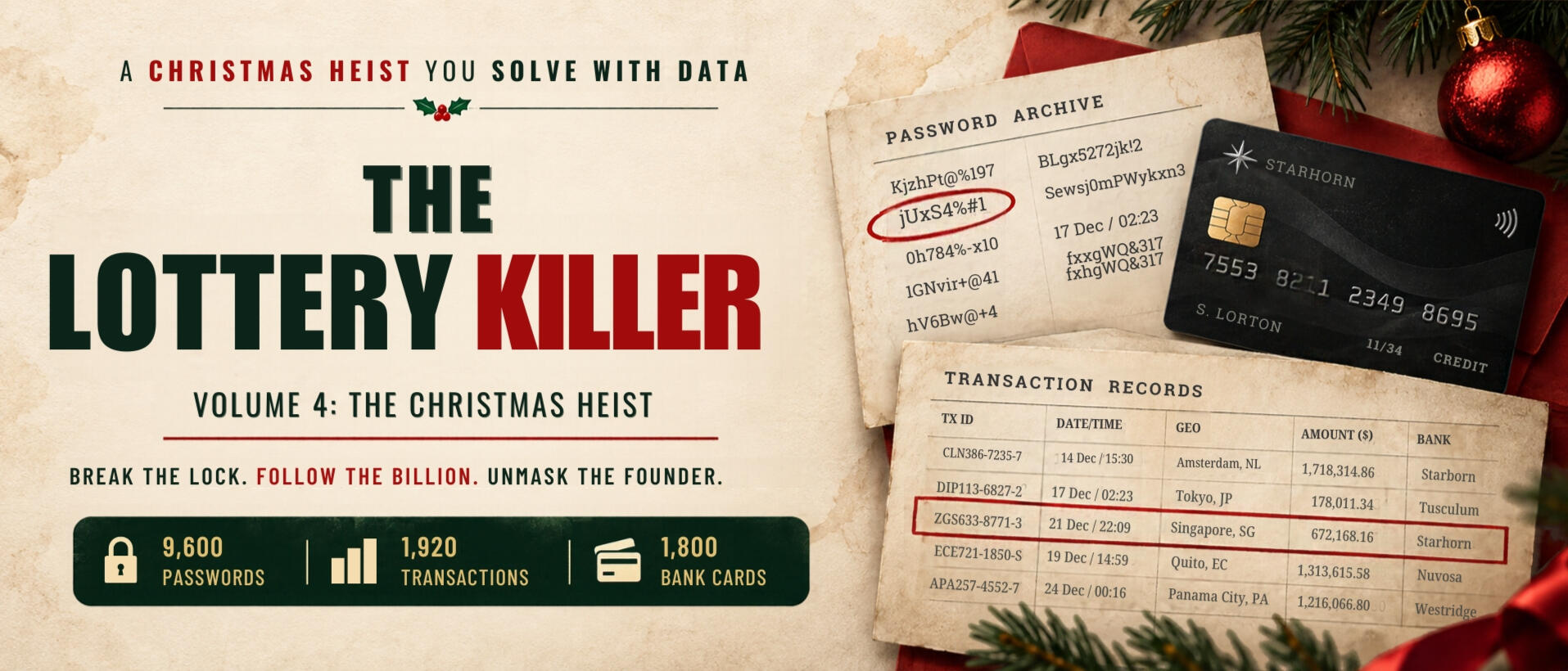
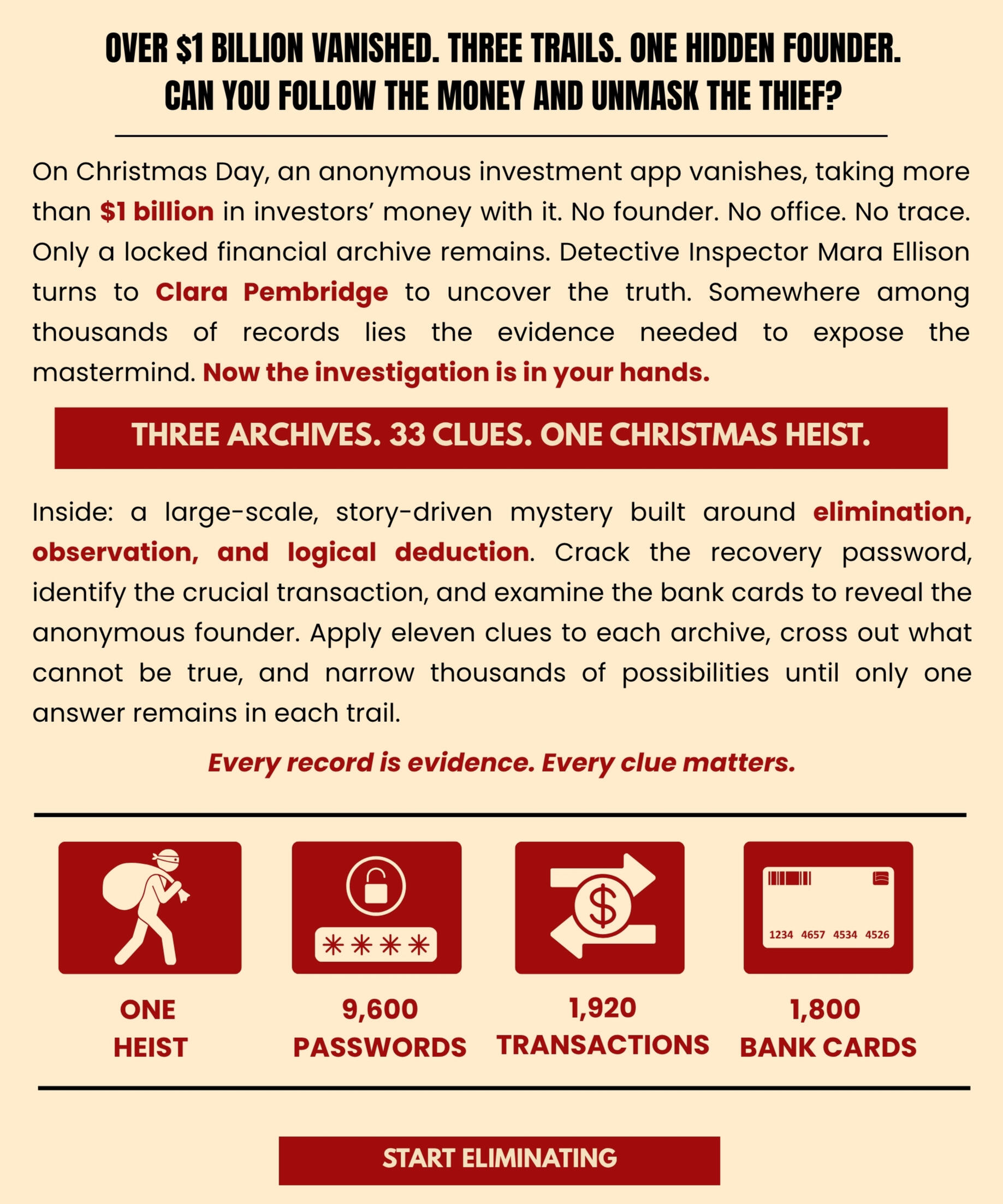
The Lottery Killer Volume 4: An Immersive Christmas Heist Logic Puzzle
by A. S. Remington
Available exclusively on Amazon
Wherever you are, you can grab a copy of "The Lottery Killer Volume 4". Just pick your local Amazon store from the links below.
Solution
The archives have given you everything they can. If you have followed every clue, eliminated the impossible, and believe you have uncovered the password, the crucial transaction, and the anonymous founder, submit your findings and confirm your answers.
Hints
Stuck between two possibilities? Click here for spoiler-safe guidance.
Clues
Looking for the clues? Click here to take a look.
Book Updates
Want to see the latest book updates? Click here for details.
FAQs
Need clarification before submitting your answer? Click here for common questions.
Contact
Questions, corrections, or feedback? If you found a printing issue, need clarification, or would like to share your thoughts about the puzzle, we would be delighted to hear from you at [email protected]

The Lottery Killer Volume 4: An Immersive Christmas Heist Logic Puzzle
Send Word to Detective
Contact
Questions, corrections, or feedback? If you found a printing issue, need clarification, or would like to share your thoughts about the puzzle, we would be delighted to hear from you at [email protected]

The Lottery Killer Volume 4: An Immersive Christmas Heist Logic Puzzle
Hints
A NOTE FROM CLARADetective Inspector Ellison didn’t call me because the evidence was hidden. She called me because there was far too much of it. Nine thousand six hundred passwords, nearly two thousand transactions, eighteen hundred cards, and almost every record looks ordinary. None of the clues asks for guesswork; they ask for patience. These are the habits that kept me from losing my place.— C. P.
Start with the Page-Sized CluesYou don’t have to apply the clues in numerical order. In every trail, several clues remove whole pages at once: the boundary clues, the facing-page and flagged-page clues, and the clues that count something across a page. Applying those first shrinks each archive dramatically before you reach the clues that test records one by one.The Printed Record Never ChangesCrossing something out removes it as a possible answer. It doesn’t remove it from the archive. Neighbors, predecessors, page counts and facing pages are always judged against the original printed pages, including entries you eliminated long ago.Read Across, Not DownThe Password Archive looks like four columns, but it isn’t read that way. Read left to right across each row, then move to the next row, and carry on across page boundaries. The cards follow the same order: Position 3’s next neighbor is Position 4, at the start of the row below.Each Trail Stands on Its OwnThe three trails tell one story, but you can solve them in any order. No answer from one trail is needed to solve another. If one archive starts to blur, switch to another and come back fresh.Copy Passwords Character by CharacterUpper and lower case matter, and so do digits that look like letters. When counting the special characters for the reference-list clue, remember that only @ # % & ? + belong to that list; ! and $ do not.Treat Every Transaction as Six Separate BoxesIn Trail Two you are eliminating cells, not rows. Draw six boxes for each candidate row (TX ID, Date/Time, Geo, Amount, Account, Bank) and cross out only the boxes a clue names. A row can lose five cells and still hold the answer in the sixth.Use the Full Bank NameThe cards show logos, not names. Match each logo against the Bank Logo Reference and use the full name exactly as printed there, including Bank, Trust or Financial, whenever a clue asks for the bank name. Compare logos carefully; a few look alike at a glance.There Are Only Five PatternsEvery card is Plain, Diagonal Lines, Waves, Geometric Grid or Dots/Speckles. Decorative differences within one category don’t create a new pattern. Decide each card’s category once, write it down, and use that label every time.Audit One Candidate at a TimeIf you end with two or three possibilities, take one and test it against all eleven clues from the start, marking each clue Pass or Fail. The missed condition usually appears within a few clues.If Too Many Survive, Check the MechanicsA large pool near the end usually means a rule was applied the wrong way, not that a clue is impossible. Recheck the reading order, the facing pages, whether crossed-out records were still counted, and whether you used the full bank names.Use the Clarifications as a Check, Not a ShortcutThe Clue Clarifications show how each clue behaves on invented examples. If you’re unsure about a clue, test your reading against its example before you continue. The examples will never point you to the answer itself.
Contact
Questions, corrections, or feedback? If you found a printing issue, need clarification, or would like to share your thoughts about the puzzle, we would be delighted to hear from you at [email protected]

The Lottery Killer Volume 4: An Immersive Christmas Heist Logic Puzzle
Frequently Asked Questions
The investigation runs across three archives: the passwords that guard the container, the transactions that reveal the route, and the cards that lead to the founder. These are the questions I’d expect most often from anyone working through them.— C. P.
Do I need the answer from one trail to solve the next?No. Each trail is solved entirely from its own archive and its own eleven clues. You can work on them in any order.Can I apply the clues in any order within a trail?Yes. Every clue is judged against the original printed archive, so the order you apply them in doesn’t change the final answer. Clues that remove whole pages are usually the quickest place to start.Do crossed-out records still count in later clues?Yes. Crossing something out removes it as a possible answer, not from the archive. Crossed-out passwords, transactions and cards still count as neighbors, predecessors, page totals and facing-page totals.Trail One — The Password ArchiveIn what order do I read the passwords?Read left to right across each row, then continue to the next row. After the last password on a page, continue with the first password on the next page. “Before”, “after” and “predecessor” always follow this order, never the columns.For Clue 1, do the boundary pages themselves survive?No. Only pages strictly between the two boundary pages remain possible. Both boundary pages are crossed out, along with every page outside them.For Clue 2, does a facing page with exactly 15 special-character starts pass?Yes. “At least fifteen” includes fifteen. Count only passwords whose very first character is one of ! @ # $ % & ? +.For Clue 3, does the flagged page itself count?Yes. A page holding a Flagged Password is distance zero from it. Pages up to four archive pages before or after it are also within range.For Clues 4 and 5, do I check across page boundaries?Yes. Count up to four (Clue 4) or ten (Clue 5) passwords on each side in continuous reading order, crossing into the previous or next page if needed. The candidate itself is never included.Does the first password in the archive pass Clue 6?No. It has no predecessor, so it fails. For the first password on any other page, the predecessor is the last password on the previous page.For Clue 7, does a change from uppercase to lowercase start a new block?No. All letters belong to one type, whatever their case. A block can be a single character. For example, Ab12@Cd34 has five blocks: Ab | 12 | @ | Cd | 34.For Clue 9, do doubled letters or overlapping pairs count?A doubled letter such as “ee” is not a pair, because a key is not next to itself. Overlapping pairs count separately: “qwe” contains two pairs (q–w and w–e). Letters separated by a digit or symbol never form a pair, and keys must be on the same keyboard row.For Clue 11, do ! and $ count?No. Only @ # % & ? + belong to the reference list. Repeated symbols count separately, so “&&” counts as two.Trail Two — The Transaction ArchiveFor Clue 1, do the two boundary pages survive?Yes, and this is the opposite of Trail One. Only the pages strictly between the two boundary TX IDs are eliminated. The boundary pages themselves stay active.For Clue 2, what if the earliest clock time appears in more than one row?Every row sharing that earliest time must appear above the largest-Amount row. If even one of them is on or below it, the whole page is eliminated. Ignore the date and compare clock times only.For Clue 3, which rows do I count?All printed rows on the page, including rows already crossed out. Exactly four banks must each appear in exactly one row.For Clue 6, can the day’s digits appear in reverse order?No. The two-digit day must appear as a consecutive pair, in the same order, within the final four-digit block of the account number.For Clue 8, must the matching country-code letter be in the same position?No. Exactly one of the two country-code letters must appear anywhere among the second and third letters of the TX ID. Both tests in the clue must pass. If either fails, cross out the TX ID, Amount and Geo cells.For Clue 10, do repeated digits count more than once?No. Count distinct digits shared by the hour and the minute, including leading zeros. For example, 12:23 passes (the 2 is shared), 12:21 fails (1 and 2 are both shared), and 12:34 fails (nothing is shared).What do I submit for Trail Two?When one cell remains, return to its row and rebuild the full printed record. On the website, enter that row’s amount exactly as printed.Trail Three — The Card ArchiveHow are card positions numbered?From 1 to 18: left to right across each row, then down. Position 1 is top left and Position 18 is bottom right. Positions are fixed by where a card is printed, never by which cards remain.For Clue 2, can a bank with only one card on the page qualify?No. A bank qualifies only when its cards on that page show at least two different patterns. Exactly four banks must qualify.For Clue 3, how do I take the digit sum of a two-digit number?Add its digits: Position 14 gives 1 + 4 = 5, and expiry month 10 gives 1 + 0 = 1. Ignore the expiry year.For Clue 4, what happens if a pair fails?Both cards in that pair are crossed out. A pair survives only if the two cards have the same bank, different patterns and opposite contactless status.For Clue 6, who are the neighbors of a card at the end of a row?The cards immediately before and after it in reading order on the same page, even if that means moving to another row. Position 3’s neighbors are Positions 2 and 4. Positions 1 and 18 always fail, because they do not have two neighbors.For Clue 7, does the initial have to appear on both card types on the same page?Yes. Look only at cards on that page with the same initial. Keep them only if at least one is DEBIT and at least one is CREDIT.For Clue 8, does the leading zero of the month matter?Yes. Compare the last two digits of each block with the month exactly as printed: for May, a block must end in 05.For Clue 9, is 0 an even digit?Yes. The even digits are 0, 2, 4, 6 and 8, and repeated digits count every time. Count only the letters of the surname, not the initial or the full stop.For Clue 10, which bank name do I use?The full name from the Bank Logo Reference, including Bank, Trust or Financial. Ignore spaces, case and repeated letters, and count the distinct letters it shares with the surname.
Contact
Questions, corrections, or feedback? If you found a printing issue, need clarification, or would like to share your thoughts about the puzzle, we would be delighted to hear from you at [email protected]

The Lottery Killer Volume 4: An Immersive Christmas Heist Logic Puzzle
Privacy Policy
We respect your privacy.When you submit your name and email address through this website, the information is used to verify your solution, respond to questions, and maintain records of puzzle submissions.If you choose to opt in by checking the newsletter and Advance Reader Team box, your email address may also be used to send occasional updates about new books, exclusive puzzles, and opportunities to receive early copies in exchange for feedback.We do not sell, rent, or share your personal information with third parties.You may unsubscribe from future emails at any time, and you may request removal of your personal information by contacting [email protected]

The Lottery Killer Volume 4: An Immersive Christmas Heist Logic Puzzle
CLUES FOR TRAIL 1
HOW TO USE THESE CLUESI have compiled eleven clues. Apply every one of them to every password and cross out each password that fails a clue. Once a password is crossed out, it stays crossed out. Work in any order you choose. The same single password will survive all eleven; that is the recovery password you are looking for.Some clues require additional reference materials, including the Flagged Passwords, Special Character Reference List, and Standard QWERTY Keyboard Layout.
CLUE 1: The correct password lies strictly between the pages containing Boundary Password A and Boundary Password B
Password A = dHbAjm++$507
Password B = 2!&&BqHa2
Locate both Boundary Passwords in the archive. Cross out every password on either boundary page and every page outside them. Only passwords on pages strictly between the two boundary pages remain possible.
CLUE 2: The page facing the correct password's page contains at least fifteen passwords that begin with a special character
For each candidate page, inspect the archive page directly opposite it. Count passwords whose first character is one of the allowed special characters. If the facing page contains fewer than 15, cross out every password on the candidate page.
CLUE 3: The correct password lies within four pages of a page containing one of the Flagged Passwords
A Flagged Password may appear on the same page or within the four archive pages before or after it. If a password is more than four pages away from every Flagged Password page, cross it out.
CLUE 4: Within four passwords before or after the correct password, at least one nearby password has fourteen or more characters
Use archive reading order: left to right across each row, then continue to the next row and across page boundaries. Check up to four passwords before and four after each candidate, excluding the candidate itself. If at least one nearby password has 14 or more characters, keep the candidate; otherwise, cross it out. At the beginning or end of the archive, check only the available neighboring passwords
CLUE 5: Within ten passwords before or after the correct password, at least one nearby password contains exactly five digits
Using the same continuous archive reading order, inspect up to ten available passwords before and ten after each candidate, excluding the candidate itself and continuing across page boundaries. If none contains exactly 5 digits, cross the candidate out.
CLUE 6: The immediate predecessor contains exactly two uppercase letters and ends in a digit
Look at the password immediately before each candidate in continuous archive reading order, including across page boundaries. If that preceding password does not contain exactly 2 uppercase letters or does not end in a digit, cross the candidate out.
CLUE 7: The correct password contains exactly five character-type blocks
Divide the password into groups of letters, digits or special characters. Each group contains only one of these three types. Count the groups from left to right. If there are not exactly 5 groups, cross out the password.
CLUE 8: The number of letters in the correct password is exactly twice the number of digits
Count alphabetic characters and digits only. Special characters do not belong to either count. If the number of letters is not exactly 2 times the number of digits, cross the password out.
CLUE 9: Exactly one pair of immediately consecutive alphabetic characters is horizontally adjacent on a standard QWERTY keyboard
Look for pairs of letters that appear directly next to each other in the password and are also side by side on the same row of a standard QWERTY keyboard. Count pairs in either direction and ignore uppercase or lowercase. If there is not exactly 1 matching pair, cross out the password.
CLUE 10: The first and last alphabetic characters are exactly nine alphabet positions apart
Find the first and last letters in the password, ignoring all digits and special characters. Using A = 1, B = 2, up to Z = 26, find the difference between their alphabet positions. If the difference is not exactly 9, cross out the password.
CLUE 11: Exactly two special characters belong to the Special Character Reference List
Count only special characters that appear on the printed Special Character Reference List. Repeated occurrences count separately. If the password contains anything other than exactly 2 reference-list special characters, cross it out.
Contact
Questions, corrections, or feedback? If you found a printing issue, need clarification, or would like to share your thoughts about the puzzle, we would be delighted to hear from you at [email protected]

The Lottery Killer Volume 4: An Immersive Christmas Heist Logic Puzzle
CLUES FOR TRAIL 2
HOW TO USE THESE CLUES:I have compiled eleven clues. This archive is cell-based: every transaction begins with six active cells. Follow each clue exactly and cross out only the page, row, column or individual cells it tells you to eliminate. Once a cell is crossed out, it stays crossed out. After all eleven clues, one cell will remain.Some clues require additional reference materials, including the Bank Code Reference and USD Locations List.
CLUE 1: The surviving cell is not on a page strictly between TX IDs GED367-3486-4 and LCE488-3784-1
Locate both TX IDs. Cross out all 6 cells in every transaction row on each archive page strictly between their two pages. The pages containing the two boundary TX IDs themselves remain active.
CLUE 2: On the surviving page, the earliest clock time appears above the row with the largest Amount
Ignore the date and compare clock times only. On each page, identify the row with the largest Amount and every row containing the earliest clock time. Every row sharing that earliest time must appear above the largest-Amount row. If any earliest-time row appears on or below the largest-Amount row, cross out the entire page, including all six cells in every transaction row.
CLUE 3: Exactly four banks occur only once on the surviving page
Count how often each bank appears on the page. A bank counts for this clue only when it appears in exactly 1 transaction row. If the number of such banks is not exactly 4, cross out the entire page, including all six cells in every transaction row.
CLUE 4: If exactly six TX IDs on a page begin with A, E, I, O or U, eliminate the Bank column on that page
Look only at the first letter of each TX ID. If exactly 6 TX IDs on a page begin with a vowel (A, E, I, O or U), cross out every Bank cell in all 32 transaction rows on that page. The other five cells in each row remain active. If the count is not exactly 6, do not cross out any cells for this clue.
CLUE 5: The bank’s two-digit reference code must equal the Amount cents in the same row
Use the Bank Code Reference at the back of the book to find the two-digit code for the bank in each transaction row. Compare this code with the two digits after the decimal point in the Amount, including any leading zero. If the digits do not match exactly and in the same order, cross out only the Amount and Bank cells in that row. The other four cells remain active.
CLUE 6: The day of the month appears consecutively inside the final four-digit Account block
Read the two-digit day from Date/Time and check only the final 4-digit block of the Account number. If those two day digits do not appear next to each other in the same order, cross out all six cells in that transaction row (TX ID, Date/Time, Geo, Amount, Account, and Bank).
CLUE 7: The country code in Geo appears on the USD Locations reference list
Use the two-letter country code printed after the city. If that code is not present on the USD Locations reference list, cross out the Geo cell only. Leave the other cells in the row unchanged.
CLUE 8: The final whole-dollar digit appears exactly twice in the first numeric TX ID block, and exactly one country-code letter appears in TX ID letters two and three
Apply both tests to each transaction row:1. Take the last whole-dollar digit of the Amount (just before the decimal point). This digit must appear exactly twice in the first three-digit numeric block of the TX ID.
2. Compare the two Geo country-code letters with the second and third letters of the TX ID. Exactly one of the two country-code letters must match.If either test fails, cross out only the TX ID, Amount and Geo cells in that transaction row. The other three cells remain active.
CLUE 9: Account Block 2 lies numerically between Blocks 1 and 3
Treat the first three two-digit blocks of the Account number as numerical values. Block 2 must be greater than one of the outer blocks and smaller than the other, regardless of their order. If Block 2 is equal to either outer block or falls outside their numerical range, cross out only the Account cell in that transaction row. The other five cells remain active.
CLUE 10: The hour and minute share exactly one distinct digit
Look only at the HH:MM clock time in each transaction row. Compare the two digits of the hour with the two digits of the minute, including any leading zero. Exactly one different digit must appear in both. If there is no matching digit or more than one different matching digit, cross out only the Date/Time cell in that transaction row. The other five cells remain active.
CLUE 11: The number of distinct digits in the four-digit checksum block equals the final TX ID check digit
Look at the four-digit block immediately before the final hyphen in each TX ID. Count how many different digits it contains, counting repeated digits only once. This count must match the single digit at the end of the TX ID. If they do not match, cross out only the TX ID cell in that transaction row. The other five cells remain active.
Contact
Questions, corrections, or feedback? If you found a printing issue, need clarification, or would like to share your thoughts about the puzzle, we would be delighted to hear from you at [email protected]

The Lottery Killer Volume 4: An Immersive Christmas Heist Logic Puzzle
CLUES FOR TRAIL 3
HOW TO USE THESE CLUES:I have compiled eleven clues. Apply every one of them to every card and cross out each card that fails a clue. Once a card is crossed out, it stays crossed out. Work in any order you choose. The same single card will survive all eleven; that is the identity you are looking for.Some clues require additional reference materials. Use the Card Position Guide and the Bank Logo Reference.
CLUE 1: The correct card is on a page containing exactly nine contactless cards
Count the cards showing the contactless symbol on each page. If the total is not exactly 9, cross out all 18 cards on that page.
CLUE 2: The correct card is on a page containing exactly four banks that each appear with more than one card pattern
Look at all 18 cards on each page and check how many different patterns appear for each bank. Count the banks that have cards with at least two different patterns. If exactly 4 banks meet this condition, the page survives. Otherwise, cross out all 18 cards on that page.
CLUE 3: The digit sum of the card-position number is different from the digit sum of the expiry month
Add the digits of the card position and separately add the digits of the two-digit expiry month. If the two sums are equal, cross that card out. If they are different, the card remains possible.
CLUE 4: A paired position survives only when the two cards have the same bank, different patterns and opposite contactless status
Use the fixed position pairs: 1–18, 2–17, 3–16, 4–15, 5–14, 6–13, 7–12, 8–11 and 9–10. Compare the two cards in each pair. They must belong to the same bank, have different patterns, and exactly one must show the contactless symbol. If any of these three conditions fails, cross out both cards in that pair.
CLUE 5: An expiry-month and card-type group survives only when it contains exactly two cards issued by different banks
On each page, look for cards that share the same expiry month and card type (DEBIT or CREDIT). Ignore the expiry year. Keep a pair only if exactly two cards share these details and they belong to different banks. Cross out any card without a matching partner, both cards if they belong to the same bank, or all cards if three or more share the same month and type. More than one valid pair may remain on a page.
CLUE 6: A card's pattern differs from both immediate neighbors, while those two neighbors share either the same pattern or the same card type, but not both
Look at the cards immediately before and after each candidate on the same page. The candidate must have a different pattern from both neighbors. The two neighbors must then match in exactly one way: either they have the same pattern but different card types (DEBIT/CREDIT), or different patterns but the same card type. If either condition fails, cross out the candidate card. Cards at Positions 1 and 18 are also crossed out because they do not have two neighbors on the same page.
CLUE 7: The cardholder initial is represented by both Debit and Credit cards on that page
For each initial, inspect every card with that initial on the same page. If the initial appears with only one card type, cross out every card carrying that initial. Keep cards only for initials represented by both Debit and Credit.
CLUE 8: Exactly one of the four card-number blocks ends with the card's two-digit expiry month
Split the 16-digit card number into its four printed 4-digit blocks. Compare the last two digits of each block with the two-digit expiry month. If zero blocks or more than 1 block match, cross the card out.
CLUE 9: The surname length equals the number of even digits in the full sixteen-digit card number
Count the letters in the surname, then count every even digit in the full card number, including repeated digits. If the two counts are not equal, cross the card out.
CLUE 10: The surname and bank name share exactly four distinct letters
Ignore case, spaces and repeated copies of a letter. Compare the distinct letters in the surname with those in the full bank name shown in the Bank Logo Reference. If their intersection contains anything other than exactly 4 letters, cross the card out.
CLUE 11: The first and last card-number digits follow the parity rule for the card's contactless status
For a contactless card, the first and last digits must have the same parity: both even or both odd. For a non-contactless card, they must have opposite parity. If the relationship does not match the card's contactless status, cross it out.
Contact
Questions, corrections, or feedback? If you found a printing issue, need clarification, or would like to share your thoughts about the puzzle, we would be delighted to hear from you at [email protected]

The Lottery Killer Volume 4: An Immersive Christmas Heist Logic Puzzle
Book UpdatesThe Lottery Killer Volume 4 is currently available in its First Edition. No revised or updated edition has been released at this time.Your copy is fully solvable using the clues and data included in the book. If a future edition or important update is released, full details will be posted here.
Contact
Questions, corrections, or feedback? If you found a printing issue, need clarification, or would like to share your thoughts about the puzzle, we would be delighted to hear from you at [email protected]
